Rattling around in a junk drawer is a classic piece of trash.
Carefully wrapped in cloth in Pistol Drawer No. 2 is a classic of the more conventional type.
The trash is a white plastic “pearlite” gripped .22 short Rohr that is evidence that God protects fools, drunks and children. It’s history is shady, at best.
It was purchased through the mail back in the early 60s by my buddy David’s Uncle David. David’s daddy was also a David, but that’s neither here nor there.
Uncle David bought the pistol from an ad in a magazine (likely a men’s magazine, if you know what I mean) after he was hired as the night guard at the local dump. It was a good job for a war veteran who had a taste for alcohol and couldn’t always be counted on to wait until after five o’clock to take a snort. It’s highly unlikely he shot anywhere near as many rats as he claimed with that Saturday Night Special, since even a rusted steel trash can was safe at five yards in daylight when the Rohr would actually go off.
He did, however, poke five holes in a car one night, rousing Mr. David and the rest of the family to come running from a mile away. No one was hurt; the suspected thieves were actually just lovebirds. Had the pot-metal cylinder not locked up, the story might have had a worse ending; as it was, the lovebirds were embarrassed enough at having their names in the newspaper.
I never understood the need for a night security guard at the dump, especially since Uncle David and his successors encouraged us to root around specific areas for “good stuff” he’d seen come in. Naturally, when Uncle David passed and my buddy David got hold of the .22, we discovered that one could shoot .22 long rifle rounds if the tips were sawed off with a pocketknife. We had fun, even if we did wear out several guardian angels.
Now, the other family piece is a bit different.
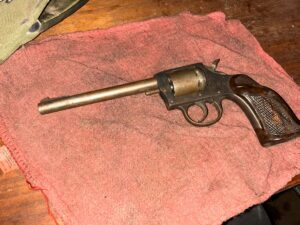
It’s an Iver Johnson Targetmaster with the owl head plastic grip, complete with thumb rest. I never quite understood why a target pistol didn’t have adjustable sights, But men were different back then.
Family tradition says my wife’s Pawpaw carried it when he was a bootlegger, during the halcyon days when he worked for the famous Percy Flowers in Johnston County, N.C. Many of the men in my bride’s family were at one point bootleggers or preachers, by the way, at least from the Depression through the 1960s.
That .22 cracked innumerable possums, coons and snakes from the tobacco barns, packhouse, garden and chicken coop before everyone moved to town and no longer had to worry about such. Unlike Uncle David, Pawpaw didn’t often regale the family with his bootlegging adventures, save the time that the rooster got drunk on the mash and started attacking everyone — including the sheriff’s deputy Pawpaw had convinced of his (Pawpaw’s) complete innocence when it came to illegal liquor.
Pawpaw was actually retired from the corn liquor business by then but had a barrel of mash hidden for a neighbor. The rooster found the mash, and Pawpaw famously popped the head off said drunken cock with that Owlhead,, leaving my aunts to cook the stringy, hateful bird for Sunday dinner.
Pawpaw had long since gone to his reward when I joined the family; I really wished I had known him, considering my dad was almost always on the “right” side of the law during those times.
My beloved late father-in-law made me cringe when he would “cowboy” the Owlhead, fanning the hammer in a room full of people. Of course, he said I was the first to load it in more than a decade, but my safety genes screamed at that click-click-click.
I eventually talked him out of it, trading a .380 I despised for Pawpaw’s pistol. Of course, the hammer never stayed back, so the only way to fire it was double-action. The trigger felt like it weighed 20 pounds.
It became my dispatch pistol on the trapline. I never kept track of what firearm I used to harvest what critter, but it’s safe to say it made some meat (and fur).
I mentioned to my gunsmith one day that on single action was a lost cause, and other smiths had tried and failed. It would work once or twice on single, but the first time you used the set trigger, it was once again DA only. His eyes lit at the challenge. All the old girl needed was a deep, deep cleaning and the proper replacement part for the set trigger.
That led to the unraveling of some family history.
Pawpaw had stopped bootlegging before the Owlhead was even manufactured in 1955; previous smiths hadn’t checked the serial number closely and just kept putting the same (older, wrong) part back into place.
My back and knees no longer let me trap, so the old girl just goes to the range, I have more efficient, “better” .22 handguns, but Pawpaw’s piece just feels right. It’s 71 years old as of this writing, but still shoots true with almost anything you feed it.
It’s not a snub by any means, what with its eight-inch barrel; it’s hard to conceal anywhere but inside a pair of chest waders or Pointer overalls. Too most folks, it’s just an old revolver.
But to me, it’s much more.
It’s a $200 cinnamon coyote in a frozen dawn. It’s a drunk rooster attacking a patrol car in a red clay barnyard. It’s the joy of teaching my wife that shooting is fun. It’s the night I tucked it into the small of my back when we sill lived in the city, and a party turned into a riot in front of our house. And yes, I even smile at my father-in-law fanning it and making sure I knew the Owlhead “didn’t work right.”
Don’t disregard those old pieces in the discount cabinet at the pawn shop, or the junk bin at the gun shop. Who knows, but once upon a time they protected the local dump from amorous teenagers, or put a possum in the pot for a family between tobacco markets.
=30-